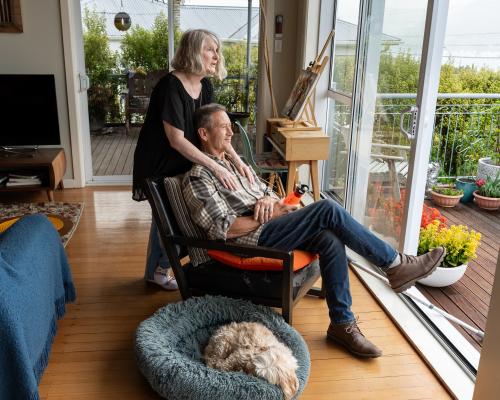
Back when she was healthy, Jane Harrison worked for the community – securing money for playgrounds, getting kids into sport and making sure her small town in New Zealand’s South Island was ready if an earthquake struck.(简·哈里森身体健康时,曾为社区工作——为游乐场争取资金,让孩子们参与体育运动,并确保她所在的新西兰南岛小镇在地震来袭时有所准备。)
简·哈里森身体健康时,曾为社区工作——为游乐场争取资金,让孩子们参与体育运动,并确保她所在的新西兰南岛小镇在地震来袭时有所准备。
Now, she and her husband, Shaun Fitzgerald, 65, are both on disability assistance(靠残疾补助生活). Last year, when Fitzgerald – a roofer(屋顶工) – was waiting for back surgery for spinal stenosis(椎管狭窄), Harrison left her job to help look after him at home. The operation in August 2025 was not as effective as hoped(效果不如预期). He has since been back into the emergency department in intense pain, waiting for hours with severe cramping(抽筋;痉挛), she says. “We called the paramedics recently and they said: ‘There’s no beds in hospital, if we take you you’ll have to sit and you clearly can’t, you’re better off at home(最好待在家里).’”
如今,她和65岁的丈夫肖恩·菲茨杰拉德都靠残疾补助生活。去年,菲茨杰拉德——一名屋顶工——因椎管狭窄等待背部手术时,哈里森辞去工作,在家照顾他。2025年8月的手术效果不如预期。她说,此后他因剧烈疼痛再次被送进急诊室,忍受严重抽筋等待数小时。“我们最近叫了急救人员,他们说:‘医院没有床位,如果我们带你去,你只能坐着,而你显然坐不了,你最好待在家里。’”
Now, as he waits for another surgery to fuse(融合;熔合) his vertebrae(椎骨) together, he is hobbling(蹒跚;跛行) around on a cocktail of(混合的;多种组合的) daily painkillers, says Harrison, 60. She has long Covid, for which she has struggled to find assistance, and her health has also worsened.(她患有长期新冠,一直难以找到帮助,健康状况也恶化了。) “It’s countless trips to the doctor, it’s so expensive, and you have to do it over and over again(一遍又一遍地).”
哈里森60岁,她说,现在他等待另一次手术将椎骨融合在一起,每天靠混合止痛药勉强行走。她患有长期新冠,一直难以找到帮助,健康状况也恶化了。“无数次去看医生,费用太高,而且你必须一遍又一遍地做。”