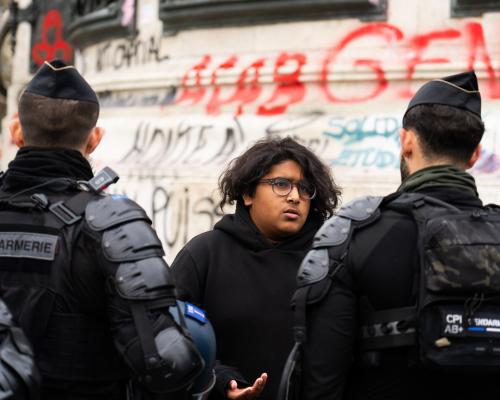
In France, it was the piles of wheelie bins stacked up against school entrances that first hinted at the scale of student anger over crumbling classrooms and teacher shortages.(在法国,最先暗示学生对破败教室和师资短缺愤怒规模的是堆在学校入口处的成堆带轮垃圾桶。) In Spain, it was a tent camp that steadily grew in the heart of the capital as residents railed against(强烈抱怨,怒斥) soaring housing costs.
在法国,最先暗示学生对破败教室和师资短缺愤怒规模的是堆在学校入口处的成堆带轮垃圾桶。在西班牙,随着居民对飞涨的住房成本怨声载道,首都中心的一个帐篷营地逐渐扩大。
Similar scenes have since sprung up in Belgium, Italy and Portugal, and clashes have convulsed Albania’s capital of Tirana, hinting at an autumn of protests across Europe.(此后,比利时、意大利和葡萄牙也出现了类似场景,阿尔巴尼亚首都地拉那的冲突震动全国,预示着整个欧洲将迎来一个抗议之秋。)
此后,比利时、意大利和葡萄牙也出现了类似场景,阿尔巴尼亚首都地拉那的冲突震动全国,预示着整个欧洲将迎来一个抗议之秋。
Much of the news coverage in recent days has focused on the violence that played out(发生,上演) on the fringes(边缘,外围) of the protests in France and Italy. The protests themselves, however, point to what seems to be a diverse response to a common crisis: the growing perception, particularly among younger generations, that governments are unable, or unwilling, to deliver when it comes to affordable housing, social equality and robust public services.(然而,抗议本身指向的似乎是对一场共同危机的多元回应:越来越多的人——尤其是年轻一代——认为,在可负担住房、社会平等和健全的公共服务方面,各国政府要么无力兑现,要么不愿兑现。)
近日的新闻报道大多聚焦于法国和意大利抗议活动边缘发生的暴力事件。然而,抗议本身指向的似乎是对一场共同危机的多元回应:越来越多的人——尤其是年轻一代——认为,在可负担住房、社会平等和健全的公共服务方面,各国政府要么无力兑现,要么不愿兑现。