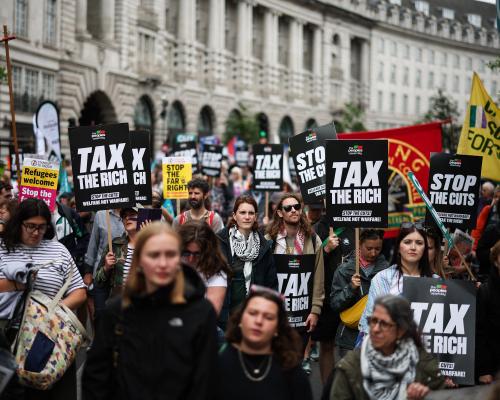
In John Healey’s first budget this week, we will finally get a sense of the economic policies that will deliver Andy Burnham’s pledge to end neoliberalism(新自由主义). Or will we? Capital gains tax equalised with income tax? Ruled out(被排除). A genuine wealth tax on those sitting on over £10m? Off the table(不在考虑之列). Even the briefed increase in the banking surcharge(附加税) only takes us back to where it was until the Conservatives cut it in 2023. We can cross our fingers(祈求好运) for trailed(预告的) policies on supporting high streets, financial devolution and longer-term investment, but there is still more than a whiff of(一丝……的气息) trickle-down economics(涓滴经济学) in the air.
本周,约翰·希利将公布他的首份预算,我们终于可以从中窥见哪些经济政策将兑现安迪·伯纳姆终结新自由主义的承诺。真的会吗?资本利得税与所得税拉平?已被排除。对资产超过1000万英镑者征收真正的财富税?不在考虑之列。就连事先透露的银行附加税上调,也只是回到保守党2023年削减之前的水平。我们或许可以指望那些预告过的政策——支持商业街、财政权力下放和长期投资——但空气中仍然弥漫着一股浓厚的涓滴经济学气息。
Poll after poll(一项又一项民调) shows that the British public overwhelmingly(压倒性地) supports wealth taxes on the super-rich – including three in five(五分之三) Reform-leaning voters. We know that wealth inequality – with the richest 50 families in the UK possessing more wealth than half of the UK population – is weakening our economy, eroding our social fabric and undermining our democracy.(我们知道,财富不平等——英国最富有的50个家族拥有的财富超过全国一半人口——正在削弱我们的经济、侵蚀我们的社会结构、破坏我们的民主。) Just last year, Burnham, then mayor of Greater Manchester, explicitly acknowledged that we have “overtaxed labour and undertaxed wealth”. So what on earth(究竟) is going on?
一项又一项民调显示,英国公众压倒性地支持对超级富豪征收财富税——包括五分之三倾向改革党的选民。我们知道,财富不平等——英国最富有的50个家族拥有的财富超过全国一半人口——正在削弱我们的经济、侵蚀我们的社会结构、破坏我们的民主。就在去年,时任大曼彻斯特市长的伯纳姆还明确承认,我们“对劳动征税过重,对财富征税过轻”。那么,究竟是怎么回事?
To solve this paradox(悖论), our team at Tax Justice UK joined forces with(与……联手) researchers at the University of Strathclyde to go straight to the source. We interviewed 30 politicians across Westminster, Holyrood and the Senedd(英国三地议会) between February and July 2026, while Keir Starmer was prime minister. We made sure, in particular, that we spoke to every faction(派系) of the Labour party in Westminster – as the party in government and the party we would expect to be predisposed to(倾向于) higher taxes on the super-rich, its opinions inevitably garner(获得) more interest. The findings offer a rare glimpse into(罕见地窥见) the hidden machinery of British politics. They suggest that the barrier to taxing extreme wealth is a deeply entrenched(根深蒂固的) pattern of political fear, economic uncertainty, institutional capture(制度俘获) and parliamentary self-preservation(议会自保). And while these interviews took place under the former leadership, our conversations with MPs since suggest that, unless Burnham commits to higher taxes on wealth, the same barriers do hold.(尽管这些采访发生在前任领导时期,但我们此后与议员的对话表明,除非伯纳姆承诺对财富征收更高税,否则同样的障碍依然存在。)
为了解开这个悖论,我们英国税务正义组织的团队与斯特拉思克莱德大学的研究人员联手,直接追根溯源。2026年2月至7月,即基尔·斯塔默担任首相期间,我们采访了威斯敏斯特、霍利鲁德和塞尼德三地的30位政客。我们尤其确保与威斯敏斯特工党的每一个派系都进行了交谈——作为执政党,也是我们预期会倾向于对超级富豪征收更高税的政党,其观点自然更受关注。研究结果让我们得以罕见地窥见英国政治隐藏的运作机制。它们表明,对极端财富征税的障碍,是一种根深蒂固的政治恐惧、经济不确定性、制度俘获和议会自保模式。尽管这些采访发生在前任领导时期,但我们此后与议员的对话表明,除非伯纳姆承诺对财富征收更高税,否则同样的障碍依然存在。