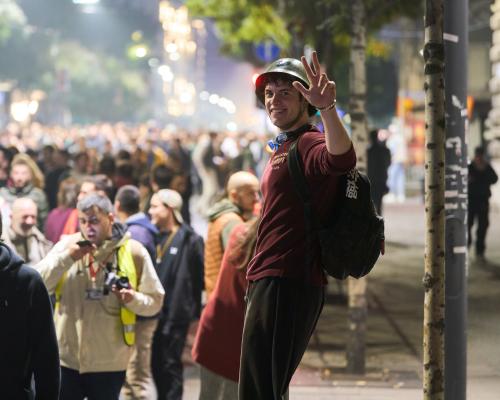
As polling stations(投票站) closed across Serbia on Sunday evening, riot police(防暴警察) were deploying around the presidency in Belgrade. Many of us feared the worst: massive electoral fraud(选举舞弊), a refusal to recognise defeat(拒绝承认败选) or outright violence. After nearly 15 years of Aleksandar Vučić’s increasingly authoritarian(专制的) rule, a peaceful transfer of power(权力的和平交接) seemed implausible(难以置信的).
周日傍晚,塞尔维亚各地投票站关闭时,防暴警察在贝尔格莱德总统府周围部署。我们许多人担心最坏的情况:大规模选举舞弊、拒绝承认败选或直接暴力。在亚历山大·武契奇近15年日益专制的统治之后,权力的和平交接似乎难以置信。
I had good reason to feel afraid. I am co-founder(联合创始人) of an annual conference on the security and foreign policy challenges shaping the western Balkans, and sit on the international advisory committee(担任国际顾问委员会成员) of a civil society thinktank(智库), the Belgrade Centre for Security Policy. Such work would be uncontroversial(无争议的) in most countries seeking European Union membership. Under Vučić’s regime, it was anything but(绝不是).
我有充分的理由感到害怕。我是一年一度的西巴尔干安全与外交政策挑战会议的联合创始人,也是公民社会智库贝尔格莱德安全政策中心国际顾问委员会的成员。在大多数寻求加入欧盟的国家,这样的工作本不会引起争议。但在武契奇的政权下,这绝非如此。
Over the past two years, our organisation has faced cyber-attacks(网络攻击) by actors suspected of links to Russian intelligence, spyware(间谍软件) attempts and relentless vilification(污名化、诋毁) by pro-regime(亲政权的) media. After one attack, investigators documented 28,000 email exchanges that had been hacked. At the same time, Serbian regime propagandists(宣传者) portrayed us as foreign conspirators(阴谋分子), while the threat of Russian-style foreign agents legislation(外国代理人法) cast a long shadow over(给……蒙上阴影) all of Serbian civil society. Had Vučić won another mandate, exile might have become a reality for many of us.
过去两年,我们的组织遭遇了疑似与俄罗斯情报机构有关联的行为者发起的网络攻击、间谍软件企图,以及亲政权媒体的持续污名化。在一次攻击后,调查人员记录了2.8万封被黑客入侵的电子邮件往来。与此同时,塞尔维亚政权的宣传者把我们描绘成外国阴谋分子,而俄式“外国代理人”立法的威胁给整个塞尔维亚公民社会蒙上长长的阴影。如果武契奇再赢得一个任期,流亡可能成为我们许多人的现实。