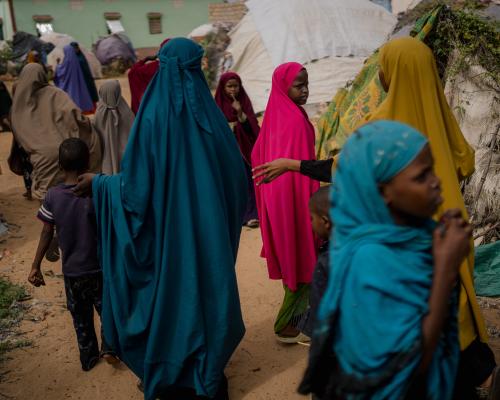
The water was rising rapidly. It had already reached Cayni Ali’s waist. Her home, five metres from the flooded(被洪水淹没的) River Juba in southern Somalia, never stood a chance(毫无机会). There was nowhere to go. Ali’s city of Jilib was under attack. Repeated airstrikes, said the mother of six, were pinning its population beside the rising river.(这位六个孩子的母亲说,反复的空袭将民众困在不断上涨的河边。)
水位迅速上涨,已经没过了凯尼·阿里的腰部。她的家距离索马里南部泛滥的朱巴河只有五米,根本无力抵挡。她无处可逃。阿里所在的城市吉利卜正遭受攻击。这位六个孩子的母亲说,反复的空袭将民众困在不断上涨的河边。
“The drones(无人机) come all the time,” said the 27-year-old. “We hear them constantly. They kill animals, civilians(平民). The town is big but destruction(破坏,毁灭) is everywhere.”
“无人机无时无刻不在,”这位27岁的女子说。“我们总能听到它们的声音。它们杀死动物,也杀死平民。城镇很大,但到处都是破坏。”
Asho Omar from Malenda, a village near Jilib, described “constant” airstrikes that had forced people towards the banks of the Juba.(来自吉利卜附近村庄马伦达的阿绍·奥马尔描述了“持续不断”的空袭,这些空袭迫使人们逃向朱巴河岸。)
来自吉利卜附近村庄马伦达的阿绍·奥马尔描述了“持续不断”的空袭,这些空袭迫使人们逃向朱巴河岸。