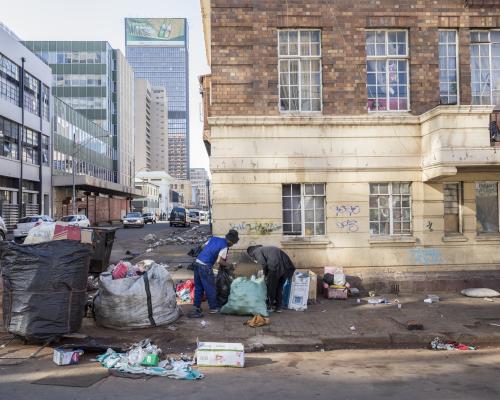
One week before the local elections in South Africa, the pavements and roads of the Johannesburg township(镇(南非种族隔离时期遗留的城镇)) Alexandra were filled with piles of rubbish, rotting in the heat. At the Jukskei River, its banks choked with(被……堵塞) rubble(碎石;瓦砾) and litter, foul-smelling(恶臭的) brown water flowed out of a culvert(涵洞;排水渠).
南非地方选举前一周,约翰内斯堡的亚历山德拉镇的人行道和道路上堆满了垃圾,在高温下腐烂。在朱克斯凯河,河岸被碎石和垃圾堵塞,散发着恶臭的棕色河水从涵洞中流出。
“We’ve got way too many(实在太多) challenges,” said Semadi Manganye, the chief executive of Alexandra Water Warriors, an environmental NGO(非政府组织) that organises clean-ups of the river and plants trees on its banks. “If it’s not electricity, it’s water. If it’s not water, it’s waste.”(不是电的问题,就是水的问题。不是水的问题,就是垃圾的问题。)
“我们面临的挑战实在太多了,”亚历山德拉水勇士组织(一个组织河流清理和河岸植树活动的环保非政府组织)的首席执行官塞马迪·曼加涅说。“不是电的问题,就是水的问题。不是水的问题,就是垃圾的问题。”
Manganye acknowledged the challenges of providing public services in a city whose population grew by 10% to 4.8 million between the 2011 and 2022 censuses.(曼加涅承认,在一个人口在2011年至2022年人口普查期间增长10%达到480万的城市提供公共服务面临挑战。) “I have an understanding of why they’re failing,” he said. “But we’ve got to mitigate(缓解;减轻) against this – we knew that it was going to happen.”
曼加涅承认,在一个人口在2011年至2022年人口普查期间增长10%达到480万的城市提供公共服务面临挑战。“我理解他们为什么失败,”他说。“但我们必须缓解这个问题——我们早就知道这会发生。”