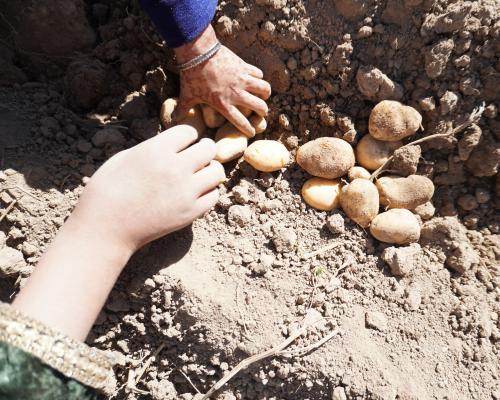
Hajra Begum rolls a potato in her hands, checking its skin for cuts, soft spots and signs of rot(腐烂). After a day harvesting in her family’s field in Chorwan, a remote mountain village in Gurez, Indian-administered Kashmir, she is sorting the crop for winter storage.(在印度管辖的克什米尔古雷兹地区一个偏远山村乔尔万,她在自家地里收割了一整天后,正分拣作物以备冬季储存。) Some of the potatoes will feed her family through the cold months(供全家度过寒冬); others will be saved for planting in spring.
哈吉拉·贝古姆把一颗土豆放在手中转动,检查表皮是否有割伤、软斑和腐烂的迹象。在印度管辖的克什米尔古雷兹地区一个偏远山村乔尔万,她在自家地里收割了一整天后,正分拣作物以备冬季储存。有些土豆将供全家度过寒冬,另一些则留作来年春天的种子。
“It should be perfect for planting,” she says. “If you keep a bad potato, you will waste the whole next year(白白浪费明年一整年).”
“它得是完美的,才能用来种,”她说,“要是留了一颗坏土豆,你明年一整年就白费了。”
Begum, 40, is preparing to lower the potatoes into a khraw(传统地下储藏坑), a traditional underground storage pit lined(内壁铺有) with straw and sealed(密封) against the cold. For generations, khraws have kept potatoes, turnips and cabbages through Himalayan winters, when heavy snowfall cuts villages off from the Kashmir valley and temperatures fall below -20C (-4F) – cold enough to crack pipes and freeze diesel.(世代以来,khraw让土豆、萝卜和卷心菜得以度过喜马拉雅的冬天。那时大雪将村庄与克什米尔谷地隔绝,气温降至零下20摄氏度,冷得能冻裂水管、冻住柴油。)
40岁的贝古姆正准备把土豆放进“khraw”——一种传统的地下储藏坑,内壁铺着稻草,密封防寒。世代以来,khraw让土豆、萝卜和卷心菜得以度过喜马拉雅的冬天。那时大雪将村庄与克什米尔谷地隔绝,气温降至零下20摄氏度(零下4华氏度),冷得能冻裂水管、冻住柴油。