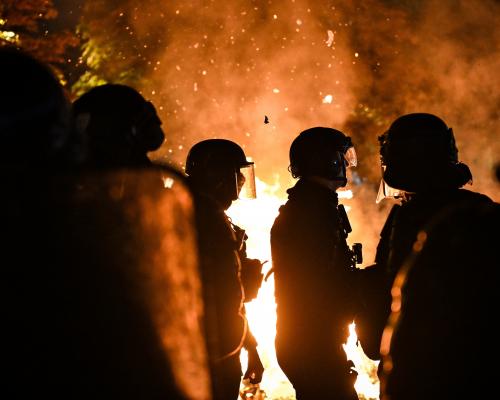
Anger at the dilapidated(破败的,失修的) state of schools may have been the starting point for the unrest(动荡,骚乱) that has rocked France for over a month, but the protest movement has grown into something much bigger. It has widened to take in(吸纳,包括) a far broader segment of society whose grievance(不满,怨愤)s, including institutional racism(制度性种族主义) and Islamophobia(伊斯兰恐惧症), are now connecting.
对学校破败状况的愤怒或许是这场撼动法国一月有余的骚乱的起点,但抗议运动已经发展成规模大得多的事物。它不断扩大,吸纳了社会更广泛的群体,这些人的不满——包括制度性种族主义和伊斯兰恐惧症——如今正相互交织。
I have no doubt that one of direct causes of this snowball effect is the repressive nature of the response to the initial protests, which were treated entirely as a matter of law and order – criminalised, not listened to.(我毫不怀疑,这种滚雪球效应的直接原因之一,是当局对最初抗议的回应具有镇压性质——抗议被完全当作法律与秩序问题处理,被刑事化,而非被倾听。)
我毫不怀疑,这种滚雪球效应的直接原因之一,是当局对最初抗议的回应具有镇压性质——抗议被完全当作法律与秩序问题处理,被刑事化,而非被倾听。
Think back to the night of 17 October – the movement’s first major mobilisation(动员,动员行动) – when the French prime minister, Sébastien Lecornu, focused his response primarily on the looting(抢劫,掠夺) in several cities. He called on the public to “choose a side(选边站)”: either “the Republic – and therefore the security forces”, or “the rioters”. The following day, President Emmanuel Macron reaffirmed “the nation’s support” for the security forces, declaring that there was “no place for violence”.(次日,总统埃马纽埃尔·马克龙重申“国家对安全部队的支持”,宣称“暴力没有容身之地”。)
回想10月17日夜晚——运动首次大规模动员——法国总理塞巴斯蒂安·勒科尔尼的回应主要聚焦于几座城市的抢劫行为。他呼吁公众“选边站”:要么站在“共和国——因而也就是安全部队”一边,要么站在“暴徒”一边。次日,总统埃马纽埃尔·马克龙重申“国家对安全部队的支持”,宣称“暴力没有容身之地”。