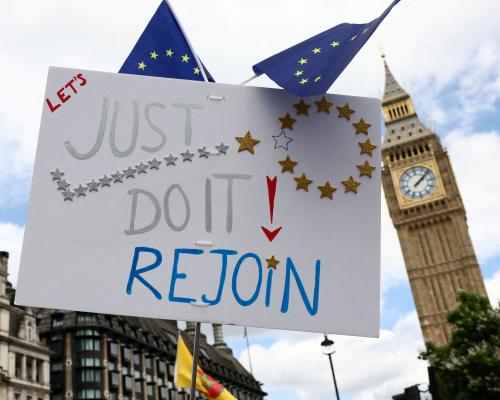
If offering the public some “breathing space” in the cost of living crisis was the mantra of last month’s budget, the political space it created to revisit our relationship with the European Union may prove more defining.(如果说给公众喘息空间是上月预算的口号,那么它创造的重新审视对欧关系的政治空间可能更具决定性。)
如果说在上月预算中为公众在生活成本危机中提供一些“喘息空间”是反复强调的口号,那么由此创造的重新审视我们与欧盟关系的政治空间,或许更具决定性意义。
I’ve spent what feels like much of the past decade immersed in(沉浸于;深陷于) the Brexit debate – first as an adviser, then helping to craft(精心制作;起草) the red lines that shaped Labour’s 2024 manifesto(宣言;竞选纲领), and latterly(最近;后来) as a Cabinet Office minister working on the EU-reset(对欧关系重置). In truth, the discussions we have had as a country and within my party on this issue have not really moved on since the moment we left on 31 January 2020.(说实话,自2020年1月31日离开以来,全国和我党内部在这个问题上的讨论并没有真正向前推进。)
过去十年的大部分时间,我似乎都沉浸在脱欧辩论中——先是担任顾问,随后参与起草塑造工党2024年竞选宣言的红线,最近又作为内阁办公室大臣致力于对欧关系重置。说实话,自2020年1月31日我们离开的那一刻起,全国以及我党内部在这个问题上的讨论,实际上并没有真正向前推进。
There’s good reason for this. The red lines we drew up in the aftermath of(在……之后;在……余波中) the Labour leadership contest(竞争;选举) in 2020 – ruling out rejoining the EU, the single market, the customs union or restoring freedom of movement – were designed precisely to close down the debate and to narrow the target that Brexit had become for Labour. They enabled us to fight the 2024 election on a manifesto that was both pro-EU, by advocating a closer relationship, but also clearly stopping short of anything that looked like rejoining the bloc or relitigating the 2016 referendum.(这些红线让我们得以在2024年大选中以一份既亲欧又明确不重新入盟的纲领参选。) Schrödinger’s Brexit(薛定谔式的脱欧:既亲欧又不入盟的矛盾状态).
这有充分理由。2020年工党领袖选举后我们划定的红线——排除重新加入欧盟、单一市场、关税同盟或恢复人员自由流动——正是为了终结辩论,并缩小脱欧对工党而言成为靶子的范围。这些红线让我们得以在2024年大选中以一份既亲欧——主张更紧密关系——又明确不触及任何看似重新入盟或重提2016年公投的纲领参选。薛定谔式的脱欧。