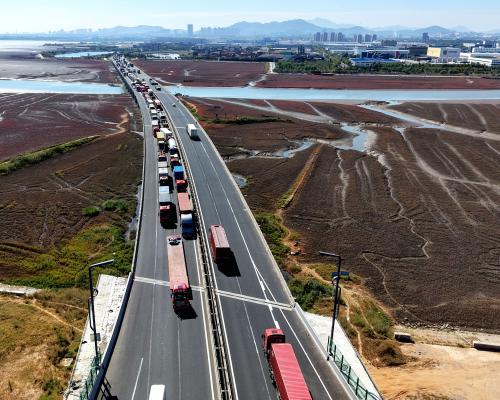
Every day, Wang Bing drives his big electric lorry(卡车) to send about five tonnes of goods between the cities of Haikou and Dongfang on Hainan, a tropical island in southern China. A round trip covers about 500 kilometres (310 miles). But refuelling(补充燃料;充电) is not something Wang worries about.
每天,王兵驾驶着他的大型电动卡车,在海南岛的海口和东方两市之间运送约五吨货物。海南是中国南部的一座热带岛屿。往返一趟约500公里(310英里)。但加油这件事并不让王兵担心。
“When my battery runs low(快用完;快耗尽), I just drive my truck into a battery-swapping station to get a fully charged one,” says the 53-year-old, who shares the journey with a colleague in eight-hour shifts(以八小时轮班方式).
“电池电量低的时候,我就把卡车开进换电站,换一块满电的电池,”这位53岁的司机说。他和一位同事以八小时轮班的方式共同跑这条线路。
Wang has been a lorry driver for nearly three decades. In the first two of those, he drove conventional(传统的;常规的) lorries fuelled by diesel(柴油). About five years ago, he began driving an electric model after the logistics(物流) company he worked for upgraded its fleet(车队). In July this year, his old e-truck, which used conventional plug-in charging(插电式充电), was replaced by one with a swappable(可更换的) battery.
王兵当卡车司机已近三十年。头二十年里,他开的是烧柴油的传统卡车。大约五年前,他所在的物流公司升级了车队,他开始驾驶电动卡车。今年7月,他那辆采用传统插电充电的旧电动卡车,换成了一辆配备可更换电池的新车。