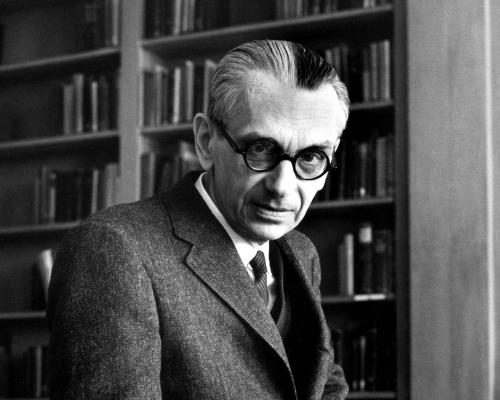
The Austrian logician(逻辑学家) Kurt Gödel was one of the most original(原创的;有独创性的) thinkers of the 20th century. His two incompleteness theorems(哥德尔不完备定理), published in 1931, transformed mathematics and paved the way for(为……铺平道路) the digital age.
奥地利逻辑学家库尔特·哥德尔是 20 世纪最具原创性的思想家之一。他于 1931 年发表的两条不完备定理改变了数学的面貌,并为数字时代铺平了道路。
After his seminal(开创性的;有重大影响的) results of the 1930s, Gödel published only a few papers. His unpublished work, however, runs to(达到(数量)) tens of thousands of pages, and is of great interest to(对……很有吸引力) historians of science.
在 20 世纪 30 年代取得开创性成果之后,哥德尔只发表了几篇论文。然而,他未发表的作品多达数万页,科学史家对此极感兴趣。
Since 2017, the Finnish logician Jan von Plato has led a project at Helsinki University to understand the contents of 16 notebooks that Gödel wrote in the early 1940s. This material – the “workbooks” – is 1,009 pages of densely(密集地;密密麻麻地) written text about maths and logic. Much of it is written in a German shorthand(速记;简写), Gabelsberger, that was obsolete(过时的;废弃的) even when Gödel was using it.
自 2017 年以来,芬兰逻辑学家扬·冯·普拉托在赫尔辛基大学领导一个项目,旨在解读哥德尔 20 世纪 40 年代初写下的 16 个笔记本的内容。这些材料——即“工作手册”——是 1009 页关于数学和逻辑的密密麻麻的文字。其中大部分用德国速记系统加贝尔斯贝格写成,这种速记在哥德尔使用它时就已经过时了。